Individual Race Result API
A precise single-race lookup endpoint for building result pages, finishers tables and post-race detail views.
Endpoint
GET/v1/results/{raceId}
- Access
- All plans
- Coverage
- UK and Ireland
- Updated
- 1 Nov 2026
- Read
- 6 min
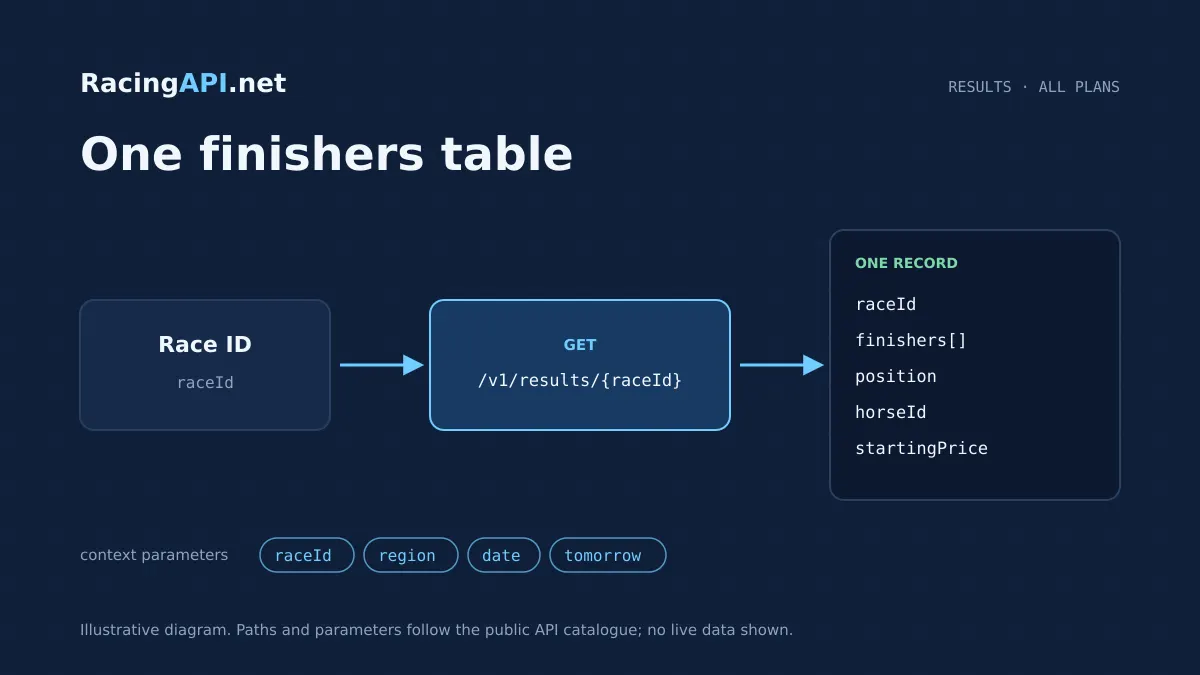
The Individual Race Result API is the single-race endpoint in RacingAPI.net for when you already know the race ID and want the published outcome for that one contest. It is designed for result screens, not browsing: send the raceId from a racecard or results feed and receive the finishers and wagers for that race in the selected feed. If the race has no published finishers yet, the endpoint returns 404, even if the racecard record itself already exists.
This service is useful when your product needs a compact, dependable race detail page rather than a results index. You can render a finishing-order table with horse identifiers, positions and starting prices where supplied, while keeping the feed’s ordering exactly as delivered. The scope is UK and Ireland together under region=uk, and you can target a specific feed date or the documented tomorrow feed when your interface is showing future entries rather than today’s published results.
What this service gives you
- Build a clean single-race result screen from one feed-driven lookup.
- Keep published finishing order and supplied prices intact in your own UI.
- Use a UK-and-Ireland combined result context without separate regional routing.
Single-result lookup, not a results directory
This endpoint is built for one known race, which is why it sits alongside the collection results feed rather than replacing it. The collection endpoint is for discovering races and building lists; this one is for drilling into a single published result page once the raceId is already in hand. That split matters in product design because it lets you keep list browsing and detail retrieval separate, with different error handling and page states.
A common integration pattern is to fetch racecards or a race list first, store the race ID from the feed, then call /v1/results/{raceId} when the user opens the result screen. Because IDs come from the feed, you should not try to reconstruct them from names or venue labels. That keeps the lookup aligned with the published record and avoids mismatches when meetings contain similar runner names or repeated race titles.
- Use it for a single result page or modal detail view.
- Use the collection results feed for index pages and result browsing.
- Use the feed-supplied raceId, not name matching, to make the request.
What you can show on the race detail screen
The response is intended to give you the essentials for a clean finishers table. You can show the finishing order as supplied, the horse identifiers from the feed, and starting prices where those are included for the race. That is enough to build a clear result panel with ranked finishers, a straightforward winner highlight and any supporting data that your front end already displays from the racecard or horse profile endpoints.
If your product shows race outcomes next to the original card, this endpoint lets you keep the page compact and unambiguous. The data belongs to the daily-feed context, so horse, jockey and trainer references should be treated as contextual profiles and statistics for the feed day, not as a guarantee of universal career-history coverage. That distinction is important if you also display links to form, connections or racecourse information.
Selecting the right feed context
The query options are deliberately limited so the result matches the feed you intended to read. region=uk is the only accepted region value, and it represents the combined UK and Ireland feed. There is no separate Ireland region code for customer access. You can also choose a specific YYYY-MM-DD date when you need the archived feed context, or use tomorrow=true for the documented tomorrow feed. Date and tomorrow cannot be combined.
This makes the endpoint practical for scheduled publishing workflows. For example, a newsroom or racecentre page can request a date-specific result after a meeting has been run, while a preview page can use tomorrow=true to keep a future race card and its eventual result slot aligned with the same race ID once it is published. Continuous archive completeness is not guaranteed, so your UI should handle the absence of a published result cleanly.
- region=uk covers both UK and Irish meetings in one combined feed.
- date selects a specific feed day in YYYY-MM-DD format.
- tomorrow=true is a separate documented mode and cannot be combined with date.
Ready to call /v1/results/{raceId}? All plans, one API key.
Recommended integration workflow
A typical build starts with the racecards or race details endpoint, where you obtain the raceId for the meeting and keep it in your application state. When the user clicks through to the result view, call GET /v1/results/{raceId} with the same region context, and add date or tomorrow only when your page is intentionally tied to a specific feed day. That gives you a stable, feed-driven path from discovery to display.
Because result pages are often opened repeatedly, many teams cache their own rendered page state rather than re-creating the race identity from scratch. Keys stay on the customer’s server, so the server-side component can handle authentication and response shaping before the front end renders the table. This is also the place to translate API error codes into user-facing messages such as ‘result not yet published’ or ‘race not found in this feed’.
How to present the finishers table clearly
The endpoint is best presented as a table with columns that match the meaning of the response, not as a generic card list. Preserve the positions as supplied by the feed, because the order is part of the published result rather than something your application should infer. Where starting prices are present, display them exactly as returned so the result row stays consistent with the race record and any later reporting on the same page.
Horse identifiers should remain the primary link target in your own system if you want to connect the result row to horse profiles, form statistics or connections data. That is safer than relying on text labels alone, because the feed ID is the durable key. If your product uses silks, remember that the silks endpoint returns PNG owner colours, not portraits, so the result page can pair the horse row with the correct visual without implying an image of the animal or person.
How this endpoint sits with racecards, odds and weather
A strong race detail page usually combines several RacingAPI.net services. The racecards feed provides the pre-race structure, this endpoint supplies the published outcome, and the odds feed can show bookmaker prices for the race where available. If you also include racecourse weather, remember that MET Norway forecasts are separate from official going and carry their own attribution and expiry. Each feed has a different job, and keeping them separate helps the page remain accurate.
The result endpoint itself does not try to invent missing context from other services. It returns finishers and wagers for the selected race only, so if a race has no published finishers yet, you get a 404 rather than a placeholder result. That makes state handling easier: pre-race pages, live pages and settled result pages can each show the right message based on the feed response instead of guessing.
- Racecards provide the pre-race structure.
- Odds provide bookmaker prices where supplied.
- Weather is a separate forecast feed, not official going.
Commercial use, quotas and plan fit
This endpoint is included on all active plans, so it is available whether you are building a small editorial site or a larger results platform. Plan choice then comes down to request volume and throughput: Developer is £29/month for 10,000 monthly requests at 2 requests/second, Professional is £79/month for 100,000 at 5 requests/second, and Enterprise is £99.99/month with unlimited monthly requests at 10 requests/second. VAT is not added.
Monthly quotas reset on the first UTC calendar day of each month. Access becomes active after on-site checkout is confirmed, and eligible new customers can receive one seven-day trial after checkout with a card; sign-up alone does not begin a trial. Subscriptions, cards and invoices remain on-site, which keeps account administration separate from the API integration itself. Keys stay on the customer’s server, and resale, onward API access and account sharing are not permitted.
Frequently asked questions
How is the Individual Race Result API different from the results collection feed?
The collection feed is for discovery across many races, while this endpoint is for one specific race once you already have its raceId. That makes it better for a detail page, a result drawer or an embedded component. It also gives you a clearer state model: one request equals one published race result for the chosen feed context.
What happens if I request a race before the result is published?
If the race exists in the racecard feed but has no published finishers yet, the endpoint returns 404. That is intentional and lets your application show a true pre-result state rather than inventing a placeholder. You should treat 404 as a valid response in workflows where result publication may lag behind the racecard.
Can I use region=ie for Irish races?
No. For customer access, the only accepted region value is uk, and that combined feed includes both UK and Irish meetings. There is no separate Ireland region code in this service. If you build your request handling around region validation, make sure it only accepts uk for this endpoint.
Should I combine date and tomorrow in the same request?
No. date selects a specific YYYY-MM-DD feed day, while tomorrow=true selects the documented tomorrow feed. The two modes are mutually exclusive. If your user interface needs both behaviours, present them as separate options so the request builder sends only one at a time.
Can I use this endpoint to build a horse career-history page?
It can contribute to that kind of page, but it is not a universal career-history database. The race result is tied to the selected feed day, and horse, jockey and trainer data should be treated as daily-feed context. For broader history views, combine this endpoint with the horse profile and form statistics feeds rather than relying on one result lookup.
Is the result order something I should sort myself?
No. Preserve the positions as returned by the feed, because the ordering is part of the published result. Your front end can format the data, highlight the winner or style placed runners, but it should not re-rank the finishers. Keeping the original sequence also helps if you need to compare the page against the source response during support.