Irish horse racing API: racecards and results
Build Irish race-day screens from RacingAPI.net using region=uk, stable race identifiers, racecards, results and connection data without mixing up UK and Irish meetings.
Published 30 Oct 2026Updated 30 Oct 20266 min read
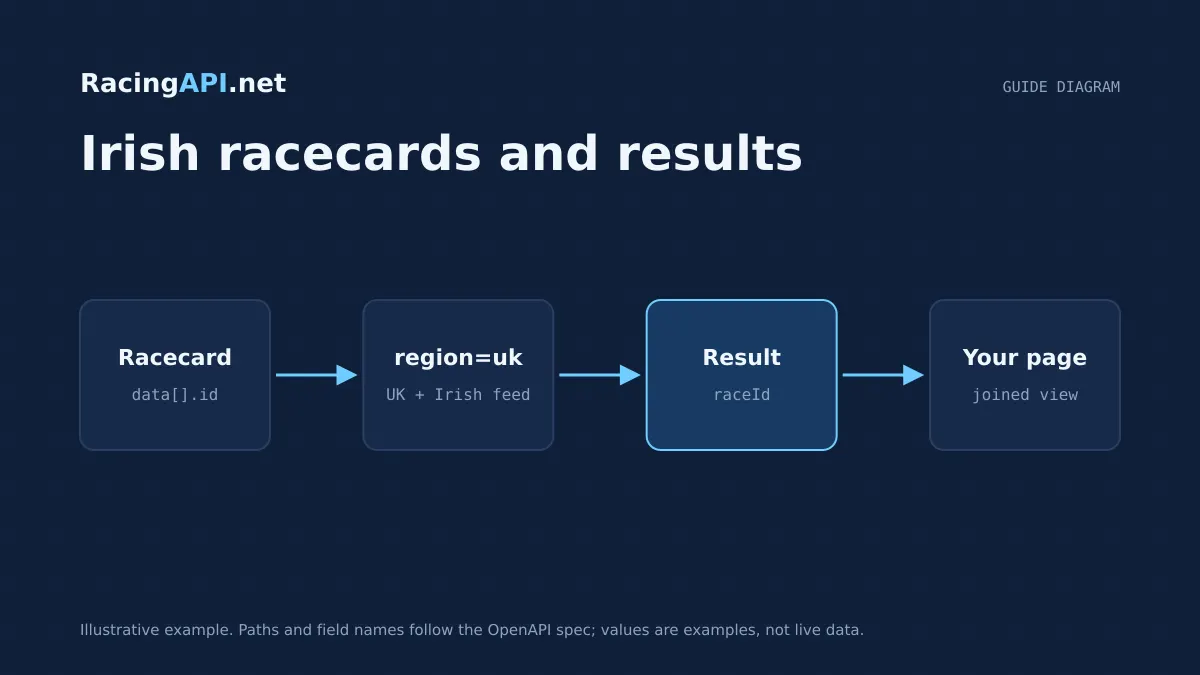
If you want Irish horse racing data without building a separate Ireland-specific pipeline, RacingAPI.net keeps the context clear: use region=uk for both UK and Irish meetings. That single region feed carries the race-day view, race identifiers, declared runners, results and the related connection data you need to render a useful Irish racing interface.
The practical rule is simple: treat the region as combined UK and Ireland, but treat each meeting, race and runner as its own object. That prevents cross-country confusion in your UI, avoids duplicate displays and keeps racecards, results and horse pages aligned when a meeting moves from declarations to the final result.
Try the documented request
Start with the combined UK and Ireland racecards. Reuse returned IDs and the selected feed date for related race, result, odds and runner requests.
# Set RACINGAPI_KEY on your server; use IDs returned by the feed.
# FEED_DATE must be YYYY-MM-DD in the feed context you want.
curl --fail-with-body --max-time 15 --get \
  "https://racingapi.net/v1/racecards" \
  -H "X-API-Key: ${RACINGAPI_KEY}" \
  --data-urlencode "region=uk" \
  --data-urlencode "date=${FEED_DATE}" \
  -H "Accept: application/json"
Run this on your server, not in public browser code. Replace the environment variables before running it. Respect the response cache headers and Retry-After; do not retry failed requests without a limit.
Use the combined region context first
For Irish coverage, the first decision is not which country code to pick, but which region context to use. RacingAPI.net uses region=uk to return both UK and Irish meetings. That means Irish racecards are part of the same daily feed as UK cards, so your application should not build separate request paths or separate assumptions about “Ireland” as an independent region.
In practice, this matters when you cache, filter and label meetings. A meeting returned from the combined feed may be Irish, but the request context is still the shared region. Keep the country identity on the meeting or course record itself, and present it in the UI from the returned data rather than inferring it from a different region parameter.
- Use region=uk for both UK and Irish meetings.
- Do not invent a separate Ireland region code.
- Label meetings from the returned course and race data, not from request assumptions.
- Expect Irish meetings to appear alongside UK meetings in one combined daily feed.
Render Irish racecards from the racecards feed
The racecards endpoint is the best starting point for Irish race-day coverage because it gives you the meeting date, course, race time, distance, going and runners. For display purposes, that is enough to build the top-level racecard page and the meeting navigation without forcing extra calls for every race in the list.
When you are building a racecard for Irish meetings, keep the identifiers stable all the way through the interface. The racecard feed gives you race-level IDs, and those should be used as the source of truth for drill-down pages, runner links and later result lookups. That avoids brittle matching on text labels such as course names or times.
- Racecard fields include id, name, course, date, time, distance, going and runners.
- Use the race id as the navigation key for race detail pages.
- Show race time and distance exactly as returned to avoid mislabelling the meeting.
- Do not rebuild runner identity from display text when an ID is already available.
Keep race and result identifiers aligned
The important integration point is the hand-off from a declared race to its final result. RacingAPI.net provides race details through /v1/races/{id} and results through /v1/results and /v1/results/{raceId}. That means the race ID should travel unchanged from the racecard screen to the results screen, even if the meeting is Irish and the page is being viewed inside a UK-wide calendar.
This is especially useful when the UI needs to show a race preview before the off and a result card afterwards. You can keep one canonical race record, then swap in the finishing positions, starting prices and result details once the result endpoint becomes available. The race identity stays the same; only the state changes.
- Use /v1/races/{id} for a single race’s declared runners.
- Use /v1/results for list-style result retrieval across the feed.
- Use /v1/results/{raceId} when you already know the race identifier.
- Keep the same race ID from preview to results to avoid mismatched records.
Show connections and form as daily-feed context
Irish runners often need more than a basic card view, but it is important not to overstate what the connections endpoints provide. Horse form statistics, jockey connections and trainer connections are supplied in the selected daily feed context. They are useful for a race-day page, but they are not a complete career database and should not be presented as one.
For an Irish racecard, the best pattern is to show the meeting, then each race, then the runner-level context that belongs to that feed date. That lets users see declared runners, horse form summary, jockey bookings and trainer connections together without implying you have full historical depth for every competitor.
- Horse form is feed-specific and varies by horse.
- Jockey and trainer connection data are not full career statistics.
- Use the daily feed date in your UI when showing form context.
- Keep the language precise: “declared runners” rather than “complete history.”
Design the display layer around proper use and reuse
Irish race-day coverage is often consumed in a live interface, so your display layer should be built to reuse the same canonical API data rather than copying it into multiple incompatible views. The customer owns their own-site display use, but API resale, redistribution and sharing an account with other developers are not allowed. That means your system should be structured for internal product use, not for republishing the feed as a shared data service.
A good display design will also separate content from presentation. For example, keep meeting labels, race times, course names, runners and result records in one model, and let the UI decide how to group them. That makes it easier to show Irish and UK meetings together while still making the country context obvious to the user.
- Keep one internal model for meetings, races, runners and results.
- Do not redistribute the feed as a shared service.
- Avoid account sharing across developers.
- Separate data storage from display logic so Irish and UK meetings can sit in the same interface safely.
Build a practical race-day flow for Irish meetings
A clean race-day flow usually starts with the racecards feed, moves into race detail pages, and then switches to results as the meeting progresses. For Irish racing, the same flow works well because the combined region feed already includes the meeting alongside UK cards. You do not need a special branch in your architecture; you need a reliable mapping from the meeting list to race IDs and then to result records.
If you want a robust user experience, treat the racecard as the preview and the result as the final state of the same race. Preserve the course, distance and race time from the racecard, then add finishing positions and starting prices once the result arrives. That keeps the page coherent whether the user lands before the off or after the final result.
- Start with the meeting list from the combined feed.
- Use race IDs to open race pages and later fetch results.
- Keep preview data and result data in the same race record.
- Present Irish meetings with clear country labelling inside the combined UK and Ireland view.
Key takeaways
- Use region=uk for both UK and Irish race-day coverage, and identify the country from the returned meeting data.
- Keep race IDs stable from racecards through race details and results so your Irish race pages stay aligned.
- Treat form and connection data as daily-feed context, not as full career history, and present Irish meetings clearly inside the combined view.
Feed-family explorer
What each family covers, with links to the documentation that defines it. Plan availability is listed on the pricing page.
Racecards
All plans- UK and Irish meetings, races and declared runners
- Supplied identifiers for joining detail requests
- Going, distance and race context as supplied
Frequently asked questions
How do I request Irish meetings in RacingAPI.net?
Use region=uk. That combined region includes both UK and Irish meetings, so you should not look for a separate Ireland code. The country should be identified from the returned meeting or course data, while the request itself stays in the shared UK-and-Ireland context.
How should I move from an Irish racecard to the result page?
Keep the race ID from the racecard and reuse it when you call /v1/races/{id} or /v1/results/{raceId}. That keeps the preview and the result tied to the same race object, which is especially useful when the meeting is Irish but displayed inside a broader UK feed.
Can I treat horse form and connections as full career records?
No. Horse form, jockey connections and trainer connections are supplied in the selected daily feed context. They are useful for race-day display, but they are not complete career-history services. Keep the wording precise in your UI so users understand the scope of the data.
Should I separate Irish and UK data into different code paths?
Usually not. A better pattern is one combined race-day flow with clear country labelling in the UI. Use the same identifiers, the same race model and the same result logic for both, then show whether a meeting is Irish or UK from the returned data rather than from a separate API branch.
Related guides
All guides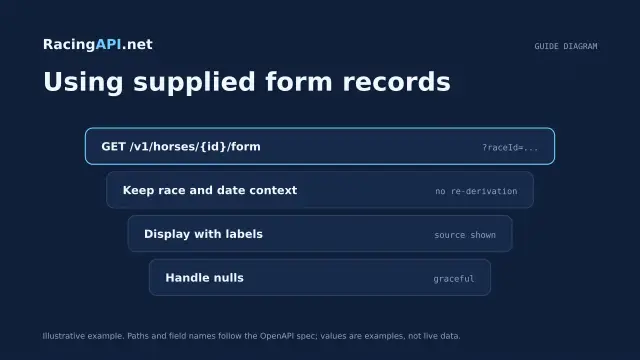 Racing data
Horse form and statistics API: using supplied records
Learn how to read RacingAPI.net horse form and statistics as supplied daily-feed summaries, with sensible handling of missing values, sample size and regional context.
 Racing data
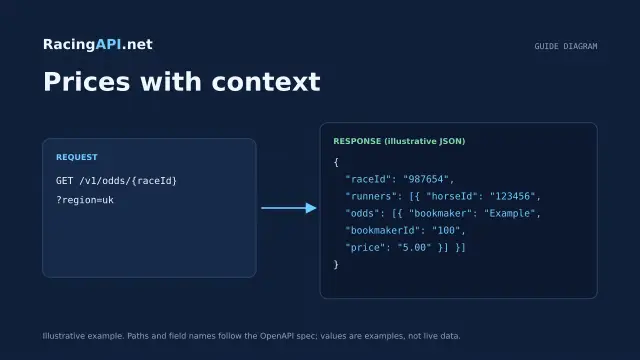
Horse racing odds API: prices with context
Learn how RacingAPI.net delivers observed horse racing odds with timestamps, price formats, missing-price handling and useful context for own-site comparison.
 Racing data
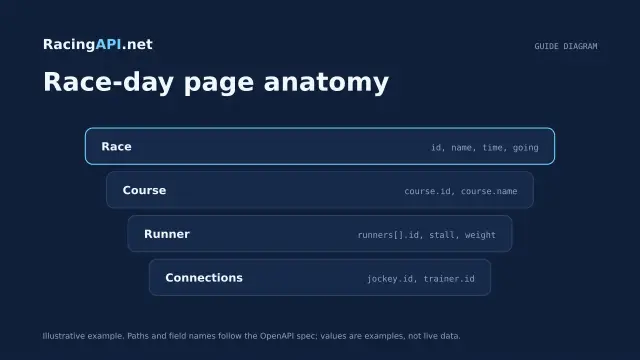
Horse racing racecards API: building a race-day page
Build a race-day page with meeting, race and runner data, careful declaration handling, and reliable detail fetching from RacingAPI.net.