AI horse racing tips API: selections for your website
Build a website layer around Enterprise saved horse racing selections, with odds, confidence, EV, bet type and two-sentence explanations.
Published 30 Oct 2026Updated 30 Oct 20267 min read
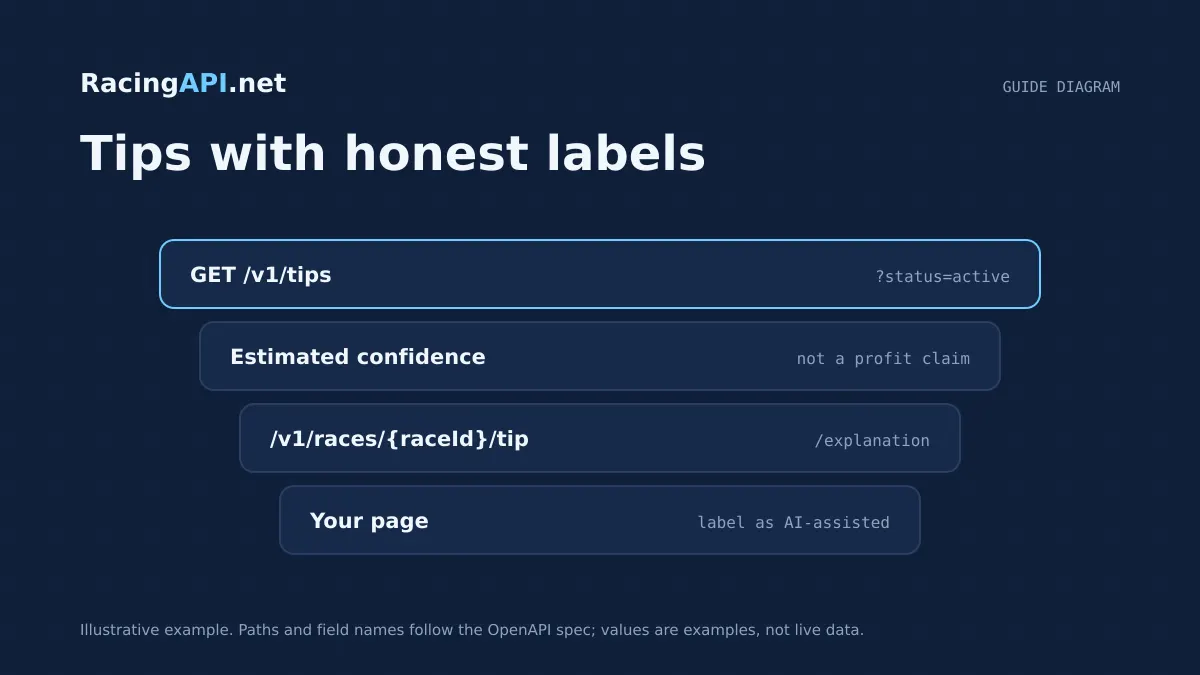
If you want to publish AI horse racing tips on your own website, the Enterprise tip endpoints give you a stable, saved result rather than a live model response every time a visitor loads the page. That matters because your frontend can render a consistent selection, explanation and odds snapshot without re-running inference on demand.
This article focuses on the fields that are actually useful for a site product: selection, market-aware odds, estimated confidence, expected value semantics, bet type, supplied connections and the saved two-sentence explanation. It also explains how the each-way rule is applied for top-three recommendations, and where the limits are so you do not overstate what the data can prove.
Try the documented request
Enterprise returns saved positive-EV selections and their two-sentence explanations. Render betType, the saved price and the supplied model fields together.
# Set RACINGAPI_KEY on your server; use IDs returned by the feed.
# FEED_DATE must be YYYY-MM-DD in the feed context you want.
curl --fail-with-body --max-time 15 --get \
  "https://racingapi.net/v1/tips" \
  -H "X-API-Key: ${RACINGAPI_KEY}" \
  --data-urlencode "region=uk" \
  --data-urlencode "date=${FEED_DATE}" \
  -H "Accept: application/json"
Run this on your server, not in public browser code. Replace the environment variables before running it. Respect the response cache headers and Retry-After; do not retry failed requests without a limit.
What Enterprise tips actually return
The Enterprise tips flow is built around saved selections for a race rather than a fresh computation on every request. In practice, that means the API can give you a raceId, selection, explanation, status and version, with a separate tips endpoint also surfacing odds and checkedAt. For a website, that is enough to display a tip card that is both readable and auditable.
The important editorial point is that these are selections, not guaranteed outcomes. You should present them as AI-assisted recommendations generated ahead of requests, not as validated win-rate claims. The version field helps you show that the explanation text belongs to a specific saved model output, which is useful when you cache pages or serve archived race views.
Because the explanation is saved, your site can avoid the awkward problem of a visitor seeing different wording for the same race depending on when they refresh. That gives you a cleaner content model: the selection is the headline, the explanation is the supporting copy, and the odds snapshot is the market context.
- Use the saved selection as the primary display item
- Show the explanation as a fixed accompanying note
- Include the version and status for traceability
- Treat odds as an observed market snapshot, not a guarantee
How to interpret odds, confidence and EV on your site
The odds returned with Enterprise tips are there to contextualise the selection, not to promise a price or a bookmaker match. That distinction matters for frontends that want to display a “best price” style card, because the API preserves observed price strings and does not claim guaranteed bookmaker coverage or refresh frequency. You should therefore present the returned price exactly as supplied, and avoid implying that the figure is universal.
Estimated confidence and EV should be treated as model outputs with practical meaning, not as proof of profit. Confidence is useful as a relative signal for comparing tips within your own site, while EV tells a reader why the model considers the market price interesting. Neither field should be rewritten into a guaranteed edge, because the API does not validate win rates or profitability.
A good website pattern is to pair the selection with a concise market note: current odds, why the price matters, and when the tip was checked. That gives readers enough context to understand why the horse appears on your page without burying them in model jargon. It also makes your content easier to archive and compare across races.
- Display odds exactly as observed
- Use confidence for ranking, not proof of success
- Describe EV as model reasoning about price, not profit certainty
- Keep checkedAt visible when you show live markets
Bet type: win or each-way, and the top-three rule
Enterprise tips can surface bet type as either to win or each way. That field is important because it changes how you explain the recommendation to visitors. A win tip is simple: the selection is the model’s preferred outright runner. An each-way tip needs more careful copy because it is tied to a place-based view of value rather than a blanket suggestion.
For this product, each-way recommendations are limited to top-three selections and only apply strictly when the price is over 5/1. That is a genuine product boundary, not a marketing flourish, so your website should reflect it in plain language. If you are building filters, make sure the each-way label only appears where the saved tip data and the price rule both support it.
Do not generalise this into a universal each-way system for every race. The safe way to present it is to describe the exact rule, then show the selected horse and price. If you need to explain place logic, keep it factual and short: the tip is each-way because the model judged the price and placing profile to support that format.
- Win tips are outright selections
- Each-way tips are restricted to top three recommendations
- Each-way applies strictly only when the odds are over 5/1
- Do not extend each-way logic to unsupported races
Using supplied connections without overclaiming history
The saved tip experience is stronger when you combine the selection with supplied connections, such as jockey and trainer context from the daily feed. That gives your page a more useful editorial feel, because the user can see who is booked and how the horse is connected in the relevant race context. The key is to keep the scope clear: this is daily-feed context, not a complete career dossier.
Avoid phrasing that implies full historical career statistics or long-term performance databases. The API supplies runner-specific form and connection statistics within the selected feed, which is enough for a race card or a tip article, but not for claims about every ride or every training season. A careful site can still be informative without overstating depth.
A practical layout is selection first, then price and bet type, then a short support block that mentions connections. This keeps the tip itself central while allowing the reader to inspect the surrounding race context. If you later archive pages, this structure also helps separate stable saved content from the day’s market snapshot.
Why saved two-sentence explanations are useful
The Enterprise explanation endpoint exists so you can reuse the same two-sentence AI-written rationale without regenerating it at page load. For a website, that is valuable because the explanation becomes part of the content record rather than a transient prompt result. Readers see the same copy on refresh, and your editors can quote it confidently.
Keep the explanation in a compact editorial box, not in a long disclaimer-heavy block. The whole point of a saved explanation is that it should read like a concise reason for the selection, tied to the race and market context. If you need more detail, add your own surrounding commentary separately, but do not rewrite the saved explanation into something different.
Because the tip and explanation are saved, you can cache pages more aggressively at your own layer without worrying that the wording will drift on every request. That said, cached content should still be scoped to the correct race and time context, especially if you also show odds. The selection may be stable, while the market snapshot can age.
Publishing tips safely on a website
If you are rendering tip pages for public visitors, structure them so the saved API response is the source of truth for the selection block and your CMS handles only presentation. That way, your site can fetch the tip, render the response in a consistent format, and reuse it across article pages, race pages or homepage widgets. Keep the raw response and your page copy clearly separated in your codebase.
For caching, the useful rule is simple: cache deliberately, and avoid letting one visitor’s personalised view leak into another’s page. Racing tips themselves are not personalised in the usual sense, but any user-specific overlays, watchlists or account notes should not be mixed into shared page caches. If you rely on odds, remember they can change, so decide whether your page should show the latest checked snapshot or an archived one.
You should also respect rate limits in your page architecture. If you are building a grid of many tips, batch your server-side work thoughtfully rather than hammering the endpoint repeatedly for the same race. The goal is a fast website that presents consistent saved selections, not a fragile frontend that depends on constant refreshes.
- Use the API as the canonical source for tip content
- Separate saved copy from your own editorial layer
- Cache with race and time context in mind
- Do not mix user-specific data into shared pages
Key takeaways
- Use saved Enterprise selections as stable website content, then layer your own design and editorial framing around them.
- Treat odds, confidence and EV as contextual signals, not as guarantees or profitability proof.
- Apply the each-way rule strictly: top three only, and only when the price is over 5/1.
Feed-family explorer
What each family covers, with links to the documentation that defines it. Plan availability is listed on the pricing page.
Racecards
All plans- UK and Irish meetings, races and declared runners
- Supplied identifiers for joining detail requests
- Going, distance and race context as supplied
Frequently asked questions
Can I show Enterprise tips directly on my own website?
Yes, as long as you present the API response accurately and keep the content scoped to your own site use. The useful pattern is to display the saved selection, odds, bet type and explanation as a single race card, then add your own layout around it without changing the meaning.
How should I explain estimated confidence and EV?
Treat both as model signals rather than proof of profit. Confidence is best used for ranking and presentation, while EV explains why the market price may be attractive. Avoid saying the model is validated profitable, because the API does not make that claim.
When does each-way apply?
An each-way selection uses three paid places at one-fifth of the win odds and is only offered when the saved odds are strictly greater than 5/1. Three places describes the place terms, not three horses being selected. Use the returned betType and place terms rather than inferring an each-way recommendation from the price alone.
Can I combine tips with jockey and trainer context?
Yes, but only as daily-feed context. The supplied connections are useful for the race page and help explain the selection, yet they are not a complete career-history product. Keep the wording specific to the selected feed and the current race.
Related guides
All guides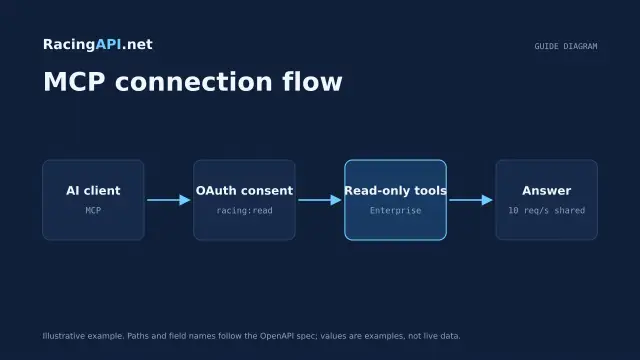 AI & integrations
Horse racing MCP: connect AI tools to RacingAPI.net
How RacingAPI.net’s Enterprise MCP server lets compatible AI clients retrieve racing tools safely, with scoped access, revocation, budgets and clear usage limits.
 Getting started
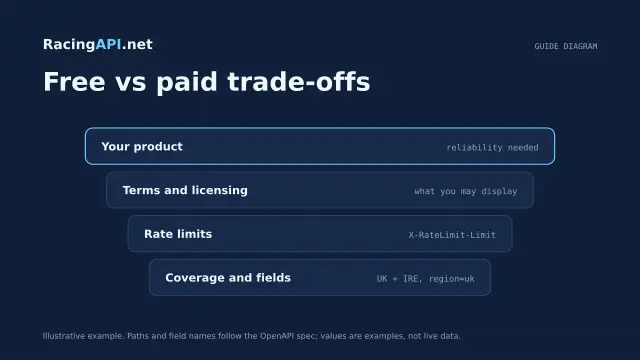
Free horse racing API: what developers should know
Learn how RacingAPI.net’s seven-day card-required trial works, what “free” really means, and how to judge an integration before your monthly plan renews.
 Racing data
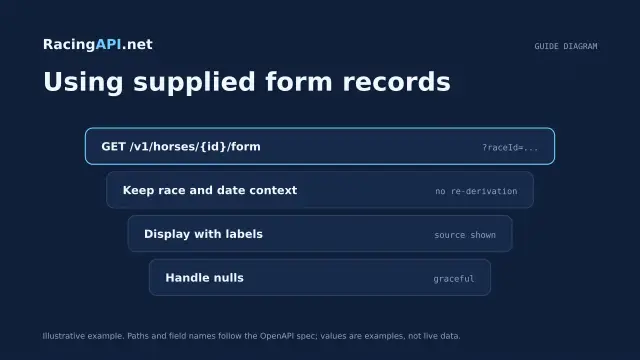
Horse form and statistics API: using supplied records
Learn how to read RacingAPI.net horse form and statistics as supplied daily-feed summaries, with sensible handling of missing values, sample size and regional context.